
AI Technology and a Breakthrough Opportunity for Vietnam’s Healthcare System
- The Current Market Landscape: Tremendous Potential, Significant Challenges
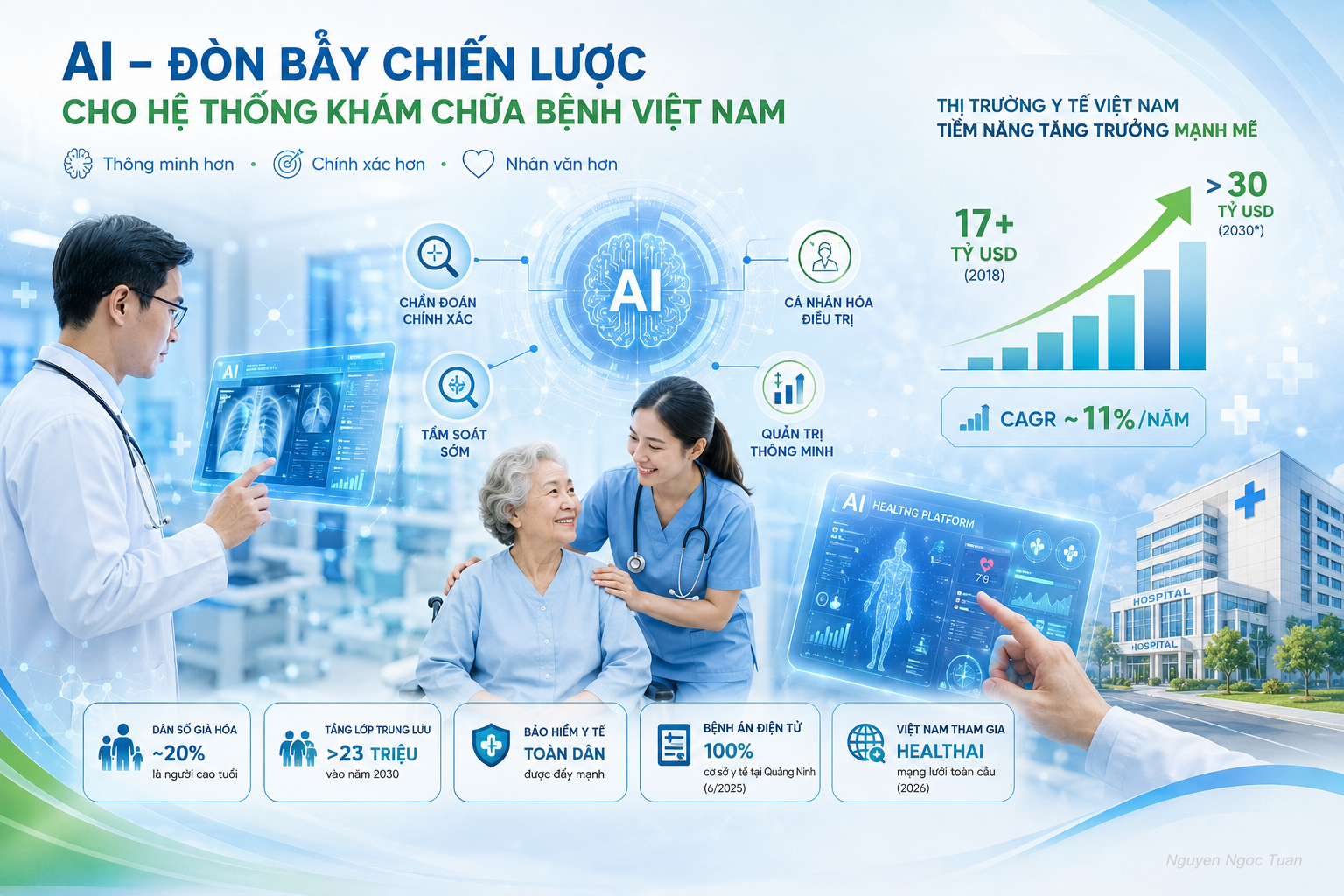
Vietnam’s healthcare market is undergoing a profound transformation. With a population of nearly 100 million, of which approximately 20% are elderly, and a middle class projected to exceed 23 million people by 2030, demand for high-quality healthcare services is rising dramatically in both urban and rural areas. National healthcare expenditure surpassed USD 17 billion (equivalent to 6.6% of GDP) in 2018 and has continued to grow at a compound annual growth rate (CAGR) of approximately 11% per year. (Source: Dan Tri News)
Several encouraging milestones deserve recognition. Vietnam’s public healthcare system has expanded to the commune level, universal health insurance coverage continues to improve, and by June 2025, Quang Ninh Province became the first locality in Vietnam to implement electronic medical records (EMRs) across 100% of its healthcare facilities. In 2026, the Vietnamese Ministry of Health officially joined the HealthAI Global Network, making Vietnam one of the world’s first ten pioneering countries in this international initiative. (Source: Tuoi Tre News)
Despite these achievements, substantial challenges remain.
Major tertiary hospitals continue to experience chronic overcrowding. Physicians work under tremendous pressure, often enduring long hours in highly stressful environments while receiving compensation that does not adequately reflect their workload and expertise.
Meanwhile, many small and medium-sized private hospitals find themselves trapped in a vicious cycle. An unstable patient base limits revenue generation, making it difficult to attract and retain highly qualified physicians and leading medical specialists. This, in turn, weakens their competitiveness and further reduces their ability to attract new patients.
Additionally, preventive healthcare remains underutilized. The widespread mindset of “only visiting a doctor when illness occurs” continues to prevail, resulting in relatively low participation in health screening programs and delayed disease detection.
- AI: A Strategic Game Changer for Healthcare
Global research has demonstrated that Artificial Intelligence in healthcare is far more than another technological tool—it serves as a “digital colleague” that empowers physicians rather than replacing them. Vietnam has already begun witnessing the tangible impact of AI across multiple medical disciplines. (Source: Tuoi Tre News)
In medical imaging, AI systems powered by deep learning reduce image noise, enhance image quality, and automatically highlight suspicious abnormalities. These capabilities enable radiologists to identify lesions earlier, faster, and with greater diagnostic consistency.
One notable example is Rapid, an AI platform developed by Stanford University, which has expanded the therapeutic window for ischemic stroke intervention from 6 hours to as long as 24 hours, allowing many patients who arrive late at hospitals to receive life-saving treatment.
In preventive medicine, AI leverages big data analytics to monitor epidemiological trends, detect potential disease outbreaks at an early stage, and support evidence-based public health policymaking.
Recognizing these benefits, Vietnam’s Ministry of Health has identified AI as a “strategic solution” for modernizing the national healthcare system while emphasizing the guiding principle:
“AI does not replace physicians; it enables physicians to deliver better healthcare.”
(Source: Ministry of Health of Vietnam)
- Practical AI Solutions for Healthcare: A Ready-to-Deploy Ecosystem
Opportunity: a comprehensive ecosystem of AI-powered healthcare solutions has been developed specifically for the operational realities of small and medium-sized private hospitals in Vietnam.
Rather than requiring massive infrastructure investments, these solutions are modular, highly scalable, and can be seamlessly integrated into existing clinical workflows.
Enhancing Screening Capacity Without Increasing Workforce
Lunit INSIGHT CXR assists physicians in interpreting chest X-rays by detecting abnormalities associated with tuberculosis, lung cancer, and other thoracic diseases.
Lunit INSIGHT MMG supports breast cancer screening through AI-assisted mammography interpretation.
AVAT automates visual acuity examinations with minimal staffing requirements.
Together, these three solutions enable hospitals to establish specialized preventive screening programs that generate new patient inflows and sustainable revenue streams—without the immediate need to recruit additional specialist physicians.
Standardizing and Accelerating Specialized Clinical Workflows
Us2.ai automatically performs cardiac ultrasound measurements and generates standardized echocardiography reports, significantly reducing examination and reporting time while increasing productivity within cardiology departments.
AliveCor 12-Lead ECG and AliveCor KardiaMobile 6L provide flexible electrocardiogram acquisition across multiple clinical settings while supporting remote cardiac monitoring services, enabling hospitals to expand cardiovascular care beyond traditional outpatient clinics.
Expanding Preventive Healthcare Services for an Aging Population
Neurowyzr DBFS provides digital cognitive impairment screening through a structured 15–20 minute assessment, automatically generating reports that benchmark each individual’s cognitive performance against age-matched populations.
As Vietnam rapidly transitions into an aging society, this solution directly addresses the growing demand for early detection of dementia and other neurocognitive disorders, allowing healthcare providers to offer proactive preventive services rather than reactive treatment.
Conclusion
Vietnam’s healthcare industry stands at a unique turning point.
Artificial Intelligence has matured sufficiently for widespread clinical deployment. Implementation costs have fallen significantly, while demand for high-quality healthcare services continues to accelerate.
Hospitals that embrace AI today will achieve far more than operational efficiency and revenue growth. They will position themselves as technology-driven healthcare providers, building a sustainable competitive advantage throughout the coming decade of digital transformation.
AI is no longer a vision of the future—it is becoming a fundamental component of modern healthcare delivery.
The hospitals that act early will define the future standards of healthcare in Vietnam.
Nguyen Ngoc Tuan
July 2026
- For any information or consultancy on Healthcare System’s digital transformation, please contact: tuan.nguyen@htaholdings.com.vn